
It is not easy for us today, with these endless spider-like tribes in all languages and cultures, to critique, evaluate, or even define poetry? And we cannot be sure, due to this unprecedented human proximity, that school curricula in the coming years will be able to guide – even if just to pass from one year to another – individuals open to parallel cultures, including the culture of the neighboring neighborhood with its poets, singers, and influencers, to read what the general taste has agreed upon as beautiful?
So, Yasmina Brihoum
The confused humanity, still grappling with the horizons opened by technology, will know how to adapt its acquisitions to the infinite novelty of change, and will establish the values that serve its goals and the standards of the arts that were used and ultimately led to applications and tools that create melodies and colors, and even stories and poems. In our Arab environment, it is enough that people still love poetry and even write it. This result reassured me as I read the collection “My Future Has Come: Previously I Walked with the Idea to Its End, Then I Continued Alone.” by the Algerian poet Ammar Meryach. I wonder if the heart of poetry stops beating when the poet disappears from sight in a culture without memory and without cultural traditions? The author of “The Abyss Followed by the Prophet,” “Discovering the Ordinary,” and “No, Oh Teacher,” chose years ago to write in silence and rejection, after the shock his language caused in poetry at that time, and leaned towards writing life just as the French writer Marguerite Duras confirms when she says: “To write is also not to speak, and to be silent is to scream without noise,” and in that, he represents the generation of shock, the generation that witnessed the transition to political pluralism in Algeria, achieving cultural pluralism through many platforms: the Meaning Group, the Poetry Magazine published by the Al-Jahiz Association, which he edited, and other activities that scattered its owners without anyone taking the torch from them.
The first thing that catches our attention in this collection is its title, as it seems that the poet still loves to place the reader on the embers of fruitful confusion, shaking the model that has narrowed the horizon of experimentation in Arabic poetry, or perhaps he is aware that he cannot return to his readers except by burying the whiteness left by his silence after “No, Oh Teacher,” bridging the gap that the events and frustrating changes have dug in the heart of a young man filled with hopes and dreams, saying in the report, which is the poem that prefaced the collection:
“Indeed: The birds have wronged me in the tree, The spiders and the mosses have wronged me.” p.20
The future/past finally announces itself and demands existence with desire and revenge, without neglecting its details as conveyed by the poet, thus revealing the face of the truth experienced by a generation that spent its youth resisting the destruction and violence that cut off its path to a future that was imminent:
“Whenever a spike split the earth… it was surrounded by cannons and harvesters.”
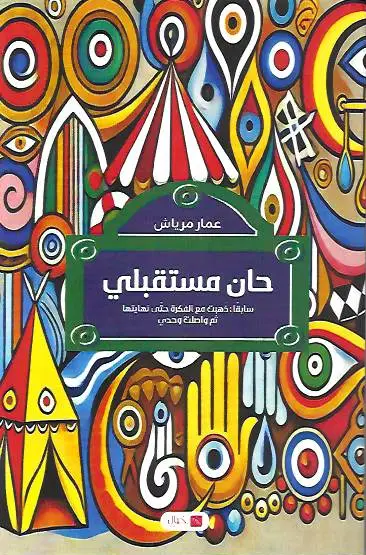
I will try to read this collection of small pieces, published by Dar Khayal this year 2024, starting from the attractive cover with its multiple and harmonious colors, which is centered by a painting on which the title is written, where the word “Previously” catches our attention with what it conceals of truths that may be obscured by the new developments and changes, as it insists on ensuring the message reaches a title that may have changed in papers and usages, reviving a memory that the poet doubts is no longer present. “Previously,” which summarizes much that may be absent from those who have not yet reached forty today, from those who heard about fear, confusion, and doubt in Algeria of the nineties, and did not experience it, brings reality back to them with a question for a question, anxiety for anxiety, and fear for fear, confirming to them that all the frustration that accompanied poetry and writing in a context that threatened life was a reality that threatened life and delayed it:
“How can I draw a horizon for others, while my future flounders in the mud? I am neither alive nor living, but I survive like an ant so that I do not vanish.” p.21
After that, we are struck in the collection “My Future Has Come” by a preface written by “Said Boutajine,” as if it were a necessary introduction, which Meryach wanted to connect the past with the present/future, restoring to our memory the specificity of the poet’s language and its uniqueness as it began to mark a turning point in Algerian poetry, whether in terms of its departure from the obligation of meter and rhyme to prose poetry or in terms of its revolution against the singular idea and oppression, as Algeria experienced within a global framework, which collapsed just as many concepts and values collapsed under the weight of imperialism, or in terms of transforming this daily Algerian experience into poetry that may seem simple and naive, yet it is the simplicity of poetry that is not betrayed by paradox and surprise, as characterized by the Algerian specificity, which often gets lost, in my opinion, in poems whose imagery and fantasies are products of the authors’ imaginations; for Meryach’s poetry does not stem from the inspirations of a utopian culture, nor from artificial and distant cultural particularities, but rather captures all the daily Algerian spirit to speak of bureaucracy, the absence of justice, and the crushing of humanity under the wheel of marginalization, and the single opinion born of extremism, which I believe the poet resisted with his words from the moment it first spread:
“The priest told me the hoopoe brought me the news… And indeed: The world will fall, it has all become a mistake.” p.30
In the poem “Attempts,” we can almost assert the unity of the theme between it and the previous poem, and we assume that the goal is to complete this narrative that is rich with the poet’s technique based also on the association that reveals a rebellious self that refuses to be silenced and constrained, and everything that the machinery of administrative and political extremism tried to uproot in the land of “pomegranates and grapes.”
It is difficult for the reader to classify the poet and his language between his excess in directness, which, upon reflection, we find is filled with music, and is not devoid of allusion and symbolism at other times, and between elusive mystical hints, all of which reveal a culture I believe is a mixture of spiritual Arab heritage and modern culture that the poet has acquired from his economic and technological background:
“He who is not blind to love knows me, and he who is not worthy to kiss his garments, my king and my beloved and my love, and it does not matter to whom I sing, to sing is enough for me.” p.31
With the ugliness and darkness of reality, the poet lives life as a poet, admitting that what matters to him is to speak poetry and resist its misery. In this, he does not place barriers between his existence and the world, as life begins with poetry and its joy and ends with it; to burden the poem with a thousand pains and a thousand hopes revealed by the images that abound in his language:
“The illusion ripened in the vase, and the water has not yet arrived.” It has become mythical birds.” p.35
How harsh is the illusion that has become a dry plant, its buds from the past and pain have become a shrine! Then the poet does not stop unsettling our expectations and shaking our reception with what we hear of voices that preserve the meter but turn the words, making us think it is a typographical error, until when we focus, we discover that the poet, who may seem to enjoy the beauty that language offers, intends to reveal to us how misleading the familiar and habitual can be, and how it unites with language until it expresses delirium, through words that lose their meaning:
“And the memories piled up like a dream in the ruins, the beast became a terrifying night, and the maids lick the leftovers. I do not accompany my false Nib and Balqi…” p.44
And always in the poem “I Am Like This,” Meryach continues to gather numerous questions and interpretations, giving identity a new dimension at a poet liberated from the dictates of politics and its necessities, returning to the beginning of history with truths that have always been on Algerian soil, affirming the patience that humans have lived on this land, and here he is today in a test harsher than all the pains that have afflicted him, drawing from the caves of his strength and all the violence that his history is filled with to confront this extremism:
“And when I found no enemies on earth, I returned to my children, brandishing my sword. I will slaughter them… to complete what I vowed to my fire. The blood must reach my horse’s shoulders, so I erase all my regret and shame.” p.51
How easy it is for us to analyze the impact of violence that appears in oral heritage, which summarizes the history of conflict as revealed by “the blood reaches my horse’s shoulders,” for who among our generation has not heard “the blood reached the knees,” the phrases that may seem contrary to the eloquent linguistic register, in