
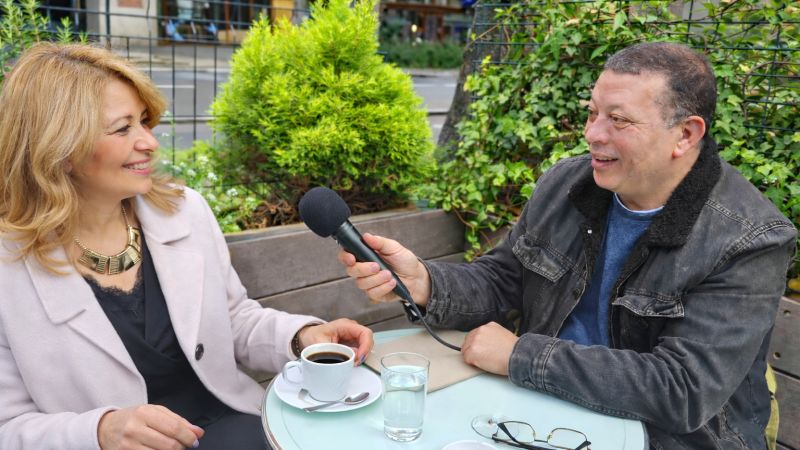
Poet of intimacy and exile, Leïla El Mahi writes as one breathes—to keep from sinking, as one reaches out a hand to those who were never able to speak. Between France and Algeria, motherhood and feminine memory, her poetry becomes an act of gentle resistance and inner reconstruction. Through her collections The Butterfly’s Flight, My “I” of Reflection, and The Enamel of My Words, she traces a sensitive journey, between pain and light, between grounding and flight. In this conversation, she reflects on her path as a writer, her plural voice, and her hope of making the human spirit resonate through the power of words.
1. Who is Leïla El Mahi as she would like to present herself?
I am Leïla El Mahi, a poet born in Paris, shaped between two shores, the France of my birth and the Algeria of my roots. A woman, a mother, I am a voice for those who, like me, have felt lost, who have not dared to express their pain. I write because I need to, but above all because others do not have the strength to do so. My writing is an inner journey, a way to connect what I have experienced to what others live in silence. I am not just an author; I am a bearer of emotions, a witness to the intimate, a messenger of resilience.
2. Between origin and becoming, what does identity represent for you: an anchor point or a poetic process in perpetual metamorphosis sculpted by the verb?
Identity is, for me, a journey. It does not settle; it moves, it seeks, it doubts. I grew up between two cultures, and this tugging forced me to build myself differently. My identity is that butterfly that flies between two worlds, in search of its own truth. And it is in the verb that I found my anchor. It is both a root and a wing. It has allowed me to understand that we do not belong solely to a country or a language, but also to what we create. In my words, I reinvent myself every day.
3. Your poems traverse the landscapes of motherhood, exile, childhood, and feminine memory. Are you writing a poetic autobiography or a collective voice for those who have not been heard?
Both. My writing is deeply intimate, but it transcends my story. Through my words, I want to be the voice of all those who could not speak, of all those who have been silenced. My “I” is a fragile yet strong “we.” What I experience, others live in silence. So I write for them too. I like to believe that each poem is a hand extended saying “I understand,” “I see you,” “you are not alone.” It is this collective resonance that gives my poetry its true meaning.
4. From one collection to another — The Flight of the Butterfly, My “I” of Reflection, The Enamel of My Words — your breath evolves. What do these metamorphoses reveal about your poetic journey?
The Flight of the Butterfly is the cry of my exile, this brutal break between two worlds. My “I” of Reflection is introspection, a return to myself, to the woman I had to rebuild. And The Enamel of My Words is care, beauty in fragility, love rediscovered, embraced. These collections are the stages of a true inner transformation. Each marks a step on my path, like white stones left behind me. They speak of my struggles, my rebirths, and my will to transform pain into a strong light.
5. You say that writing is a form of healing, a way to resist pain. But does the poem heal, or does it simply make us more lucid in the face of the wound?
Writing does not heal everything, but it liberates. It has allowed me to traverse my pains without sinking, to transform them into strength. The poem does not make the wound disappear, but it illuminates it, it honors it. It allows one to live with it, to no longer be ashamed of it. It is a mirror that reflects my being. It also becomes a kind of catharsis: by giving shape to emotions, I tame them. Pain ceases to be a prison and becomes a source.
6. You say: “I am a woman, I am pride and resistance.” Is this a poem of pride, a feminist manifesto, a form of gentle resistance, or the expression of an inner matrix that shapes your relationship with the world? And how does this manifest in your daily life?
It is an affirmation, born from my life as a divorced woman, a mother, a daily fighter. I have often faced walls, but I have never stopped moving forward. This phrase is my way of saying that I exist, fully, despite the trials. In my daily life, this translates into my simplicity, my determination, and the love I convey to my children and my readers. Being a woman, for me, is not just an identity; it is a struggle and a pride. Every day, I choose to stand tall, to raise my voice, to believe that my words can inspire others not to give up.
7. You are a poet, a cultural facilitator, an educator, a plural citizen. How does this multiplicity nourish your poetic voice? Do you write from the margins or from an intimate center?
I write from this intimate center shaped by the margins. My journey is made of transitions, exiles, adaptations. This richness nourishes my pen. I carry within me fragments of intersecting lives, shared experiences, traversed pains. All of this has forged me, and it is from this beating heart that I write. Each role I take on offers me a new perspective on the world, and it is from this crossroads that my poems are born, both intimate and universal, singular and collective.
8. Jallâl ad-Dîn Rûmî, Tolstoy, Nietzsche, Coelho, Baudelaire… You often cite these figures. Do you think that poetry is an infinite work through time and poets, constantly reborn? How does your voice harmonize with this long journey?
Yes, poetry is an ancestral breath that traverses the centuries and is reborn with each inspiration of poets. I humbly place myself within this continuity. My voice adds its color, its grain, its scar. I am one more stone in this infinite edifice that is human poetry. I believe that each poet is an echo of others, a new variation on the same universal melody. My role is to extend this music by adding my perspective.
9. How do you experience cultural life in France? Do you find a true space for expression and belonging there?
There are spaces, but often one must create them oneself, and I decided not to wait for an invitation; I took up the pen to exist. Today, thanks to my writings and those who receive them, I carve my own path in French culture. Cultural life can sometimes be closed, selective, but poetry has the power to break down barriers. It allows me to be where I am not expected, to exist without asking for permission.
10. If you had to summarize your poetic experience in one sentence — not as a definition, but as a confession — what would you say?
Writing saved me from oblivion, made me free, allowed me to love without betraying myself. It is my breath, my memory, my truth, the space where I am never a stranger.
11. Before concluding… a dream, a wish, a project, or a resolution that you carry within you and would like to share?
I have already sown a few seeds of dreams: I created Vers et Voix, a poetic space that I animate with passion, where words meet music. I have organized poetic and musical events, and I even had the joy of bringing a festival to life, driven by the conviction that poetry can bring people together. But this is just the beginning. I wish to continue exploring other forms of writing, to venture into novels, short stories, to give life to other narratives. Stories will soon emerge, a natural extension of my pen, but with new colors. My dearest wish? That my words, whether verses or prose, continue to resonate with humanity, that they touch hearts and transcend time.